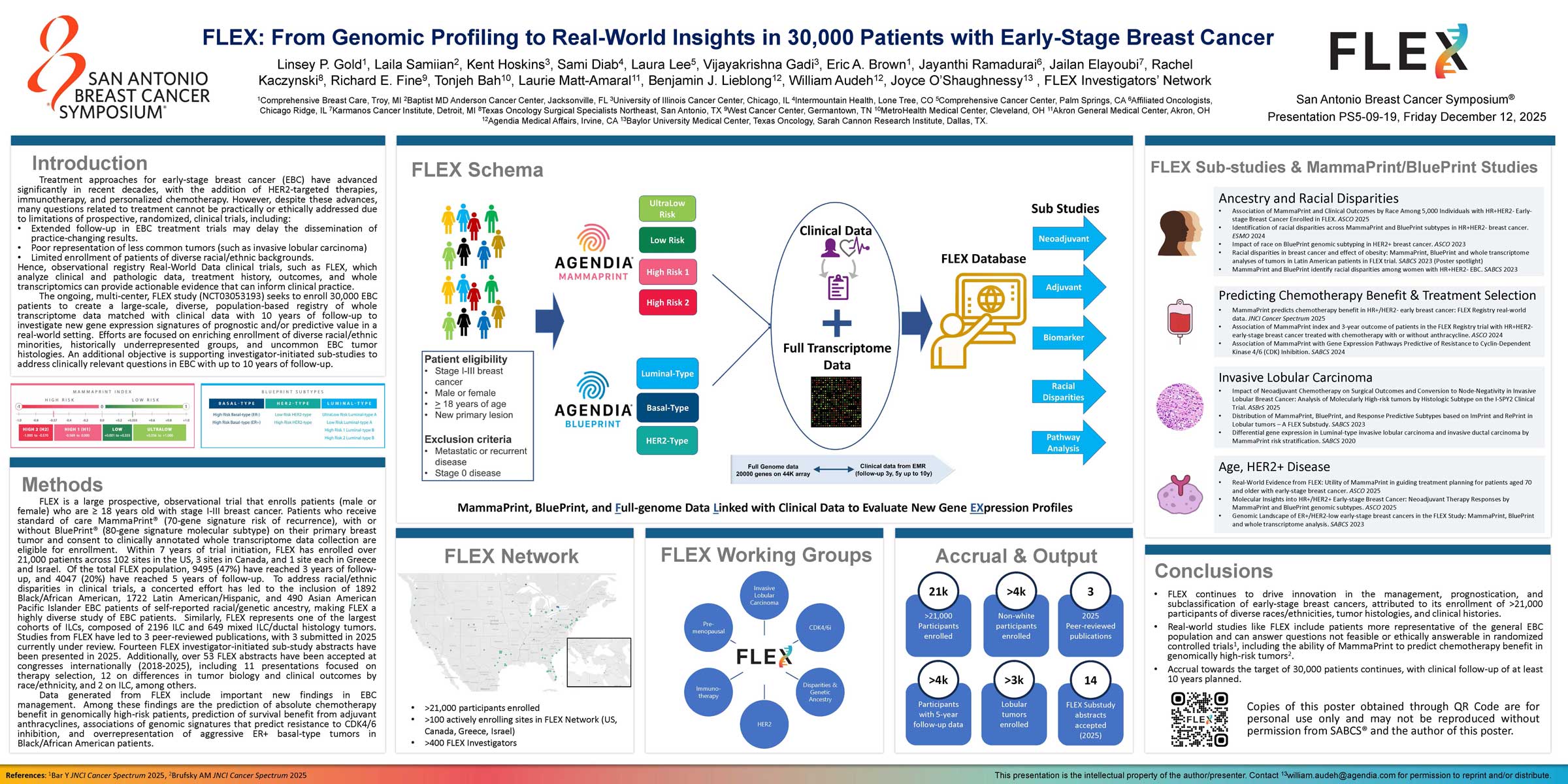
Publication: SABCS 2025, Presentation ID: PS5-09-19
Authors: Gold et al.
Title: FLEX: From Genomic Profiling to Real-World Insights in 30,000 Patients with Early-Stage Breast Cancer
Introduction:
Treatment approaches for early-stage breast cancer (EBC) have advanced significantly in recent decades, with the addition of HER2-targeted therapies, immunotherapy, and personalized chemotherapy. However, despite these advances, many questions related to treatment cannot be practically or ethically addressed due to limitations of prospective, randomized, clinical trials, including:
- Extended follow-up in EBC treatment trials may delay the dissemination of practice-changing results.
- Poor representation of less common tumors (such as invasive lobular carcinoma)
- Limited enrollment of patients of diverse racial/ethnic backgrounds.
Hence, observational registry Real-World Data clinical trials, such as FLEX, which analyze clinical and pathologic data, treatment history, outcomes, and whole transcriptomics can provide actionable evidence that can inform clinical practice.
The ongoing, multi-center, FLEX study (NCT03053193) seeks to enroll 30,000 EBC patients to create a large-scale, diverse, population-based registry of whole transcriptome data matched with clinical data with 10 years of follow-up to investigate new gene expression signatures of prognostic and/or predictive value in a real-world setting. Efforts are focused on enriching enrollment of diverse racial/ethnic minorities, historically underrepresented groups, and uncommon EBC tumor histologies. An additional objective is supporting investigator-initiated sub-studies to address clinically relevant questions in EBC with up to 10 years of follow-up.
Methods:
FLEX is a large prospective, observational trial that enrolls patients (male or female) who are ≥ 18 years old with stage I-III breast cancer. Patients who receive standard of care MammaPrint® (70-gene signature risk of recurrence), with or without BluePrint® (80-gene signature molecular subtype) on their primary breast tumor and consent to clinically annotated whole transcriptome data collection are eligible for enrollment. Within 7 years of trial initiation, FLEX has enrolled over 21,000 patients across 102 sites in the US, 3 sites in Canada, and 1 site each in Greece and Israel. Of the total FLEX population, 9495 (47%) have reached 3 years of follow-up, and 4047 (20%) have reached 5 years of follow-up. To address racial/ethnic disparities in clinical trials, a concerted effort has led to the inclusion of 1892 Black/African American, 1722 Latin American/Hispanic, and 490 Asian American Pacific Islander EBC patients of self-reported racial/genetic ancestry, making FLEX a highly diverse study of EBC patients. Similarly, FLEX represents one of the largest cohorts of ILCs, composed of 2196 ILC and 649 mixed ILC/ductal histology tumors. Studies from FLEX have led to 3 peer-reviewed publications, with 3 submitted in 2025 currently under review. Fourteen FLEX investigator-initiated sub-study abstracts have been presented in 2025. Additionally, over 53 FLEX abstracts have been accepted at congresses internationally (2018-2025), including 11 presentations focused on therapy selection, 12 on differences in tumor biology and clinical outcomes by race/ethnicity, and 2 on ILC, among others.
Data generated from FLEX include important new findings in EBC management. Among these findings are the prediction of absolute chemotherapy benefit in genomically high-risk patients, prediction of survival benefit from adjuvant anthracyclines, associations of genomic signatures that predict resistance to CDK4/6 inhibition, and overrepresentation of aggressive ER+ basal-type tumors in Black/African American patients.
Results:
>21,000 participants enrolled
>4k non-white participants enrolled
Three 2025 peer-reviewed publications
>4k participants with 5-year follow-up data
>3k lobular tumors enrolled
14 FLEX Sub-study abstracts accepted (2025)
>100 actively enrolling sites in FLEX Network (US, Canada, Greece, Israel)
>400 FLEX Investigators
Conclusions:
- FLEX continues to drive innovation in the management, prognostication, and subclassification of early-stage breast cancers, attributed to its enrollment of >21,000 participants of diverse races/ethnicities, tumor histologies, and clinical histories.
- Real-world studies like FLEX include patients more representative of the general EBC population and can answer questions not feasible or ethically answerable in randomized controlled trials, including the ability of MammaPrint to predict chemotherapy benefit in genomically high-risk tumors.
- Accrual towards the target of 30,000 patients continues, with clinical follow-up of at least 10 years planned.