Publication: SABCS 2025, Presentation ID: PS4-09-09
Authors: Mazo Canola et al.
Title: Distinct Immune and Metabolic profiles in Latin American Breast Cancer Patients With Obesity Enrolled in FLEX
Introduction:
- Latin American (LA) women are more often diagnosed with aggressive early breast cancer (EBC) than Non-Hispanic White (NHW) women1.
- Prior work showed elevated immune gene expression in BluePrint® (BP) Luminal B tumors from LA patients (pts) with obesity vs Black and NHW cohorts.
- Although high immune activation is characteristic of aggressive subtypes such as Basal breast cancer—and can be associated with improved survival—its role in the distinct biology observed in LA women remains unclear
- In this study, we present:
- i. updated clinical comparisons between LA, NHW, and Black pts with EBC.
- ii. Whole transcriptome analysis (WTA) comparing BP Luminal B and Basal BC in pts with obesity.
Methods:
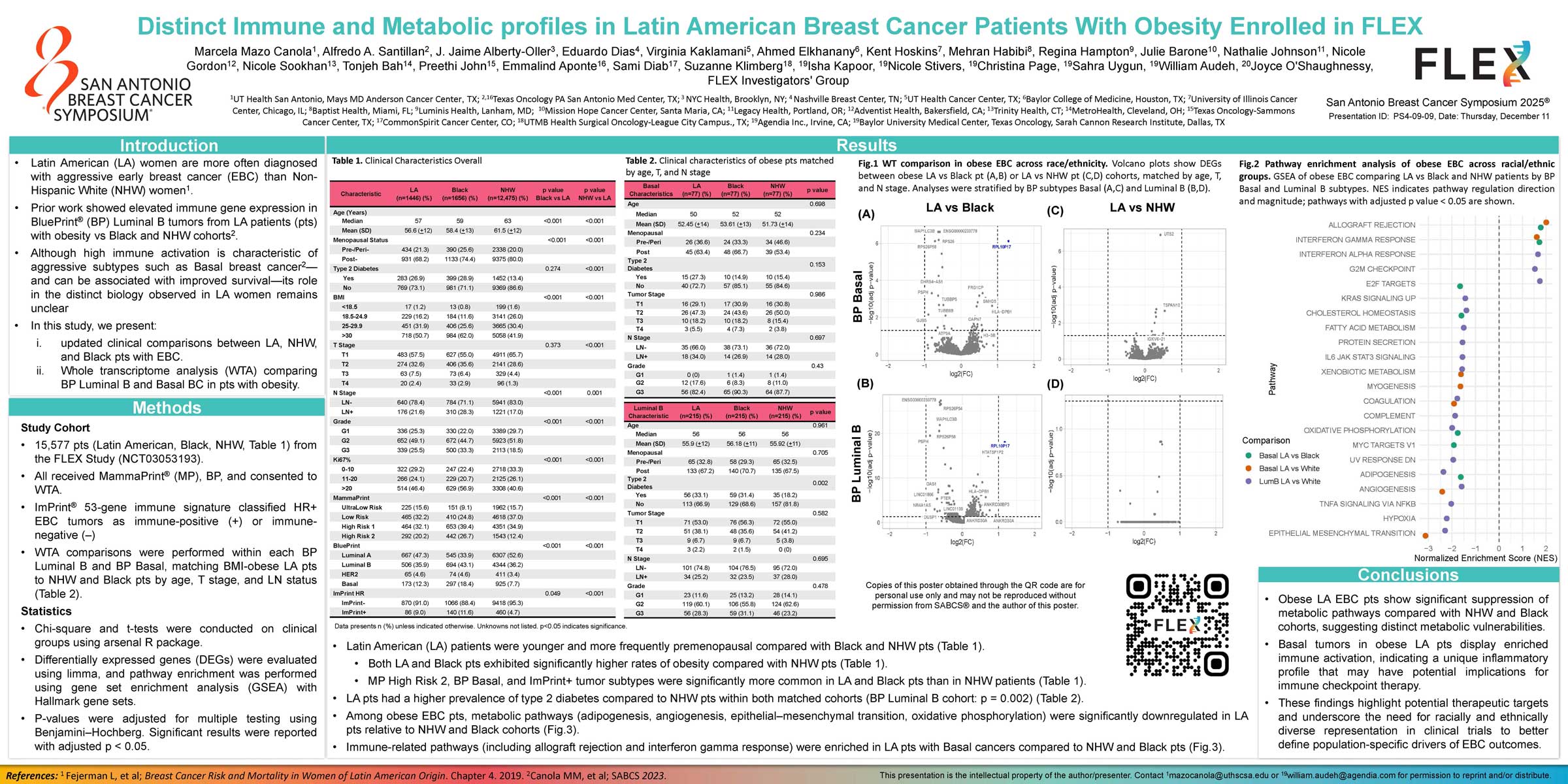
- 15,577 pts (Latin American, Black, NHW, Table 1) from the FLEX Study (NCT03053193).
- All received MammaPrint® (MP), BP, and consented to WTA.
- ImPrint® 53-gene immune signature classified HR+ EBC tumors as immune-positive (+) or immune-negative (–)
- WTA comparisons were performed within each BP Luminal B and BP Basal, matching BMI-obese LA pts to NHW and Black pts by age, T stage, and LN status (Table 2).
Results:
- Latin American (LA) patients were younger and more frequently premenopausal compared with Black and NHW pts (Table 1).
- Both LA and Black pts exhibited significantly higher rates of obesity compared with NHW pts (Table 1).
- MP High Risk 2, BP Basal, and ImPrint+ tumor subtypes were significantly more common in LA and Black pts than in NHW patients (Table 1).
- LA pts had a higher prevalence of type 2 diabetes compared to NHW pts within both matched cohorts (BP Luminal B cohort: p = 0.002) (Table 2).
- Among obese EBC pts, metabolic pathways (adipogenesis, angiogenesis, epithelial–mesenchymal transition, oxidative phosphorylation) were significantly downregulated in LA pts relative to NHW and Black cohorts (Fig.3).
- Immune-related pathways (including allograft rejection and interferon gamma response) were enriched in LA pts with Basal cancers compared to NHW and Black pts (Fig.3).
Conclusions:
- Obese LA EBC pts show significant suppression of metabolic pathways compared with NHW and Black cohorts, suggesting distinct metabolic vulnerabilities.
- Basal tumors in obese LA pts display enriched immune activation, indicating a unique inflammatory profile that may have potential implications for immune checkpoint therapy.
- These findings highlight potential therapeutic targets and underscore the need for racially and ethnically diverse representation in clinical trials to better define population-specific drivers of EBC outcomes.